Output Expected to Drop by 48% Amid Climate Challenges
Iran Pistachio Production Forecast for the 2025/2026 Crop Year
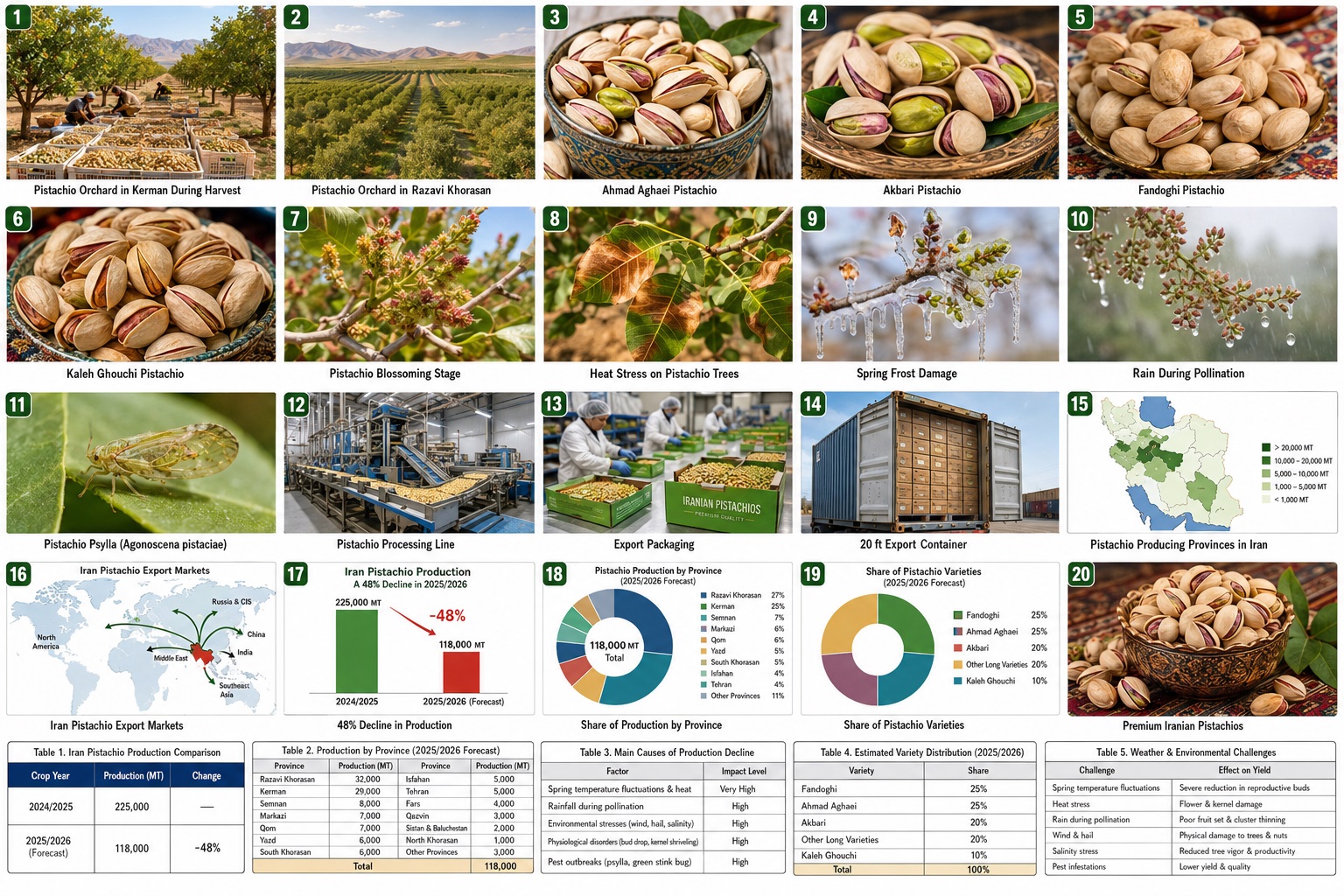
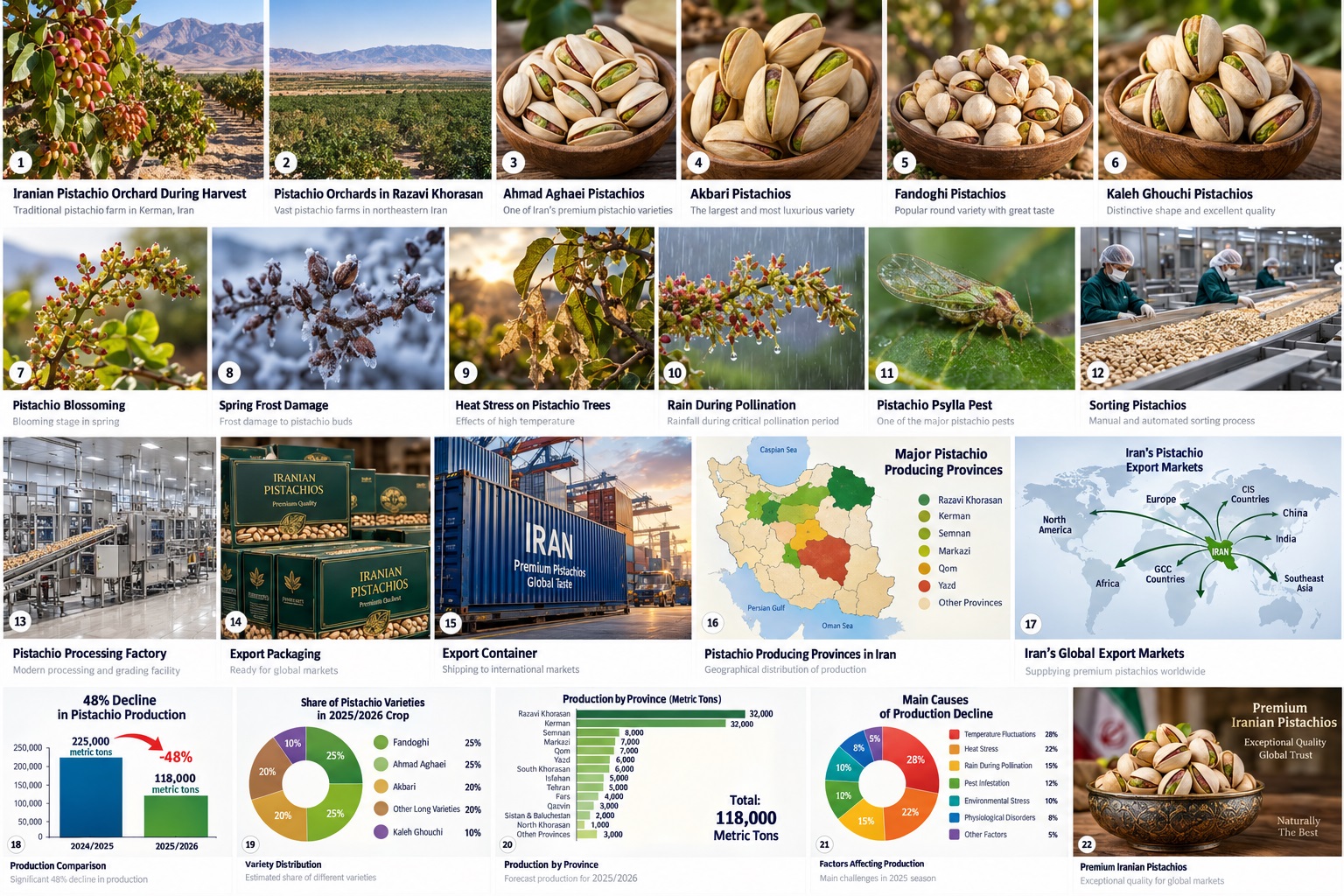
Iran, one of the world’s leading pistachio producers and exporters, is expected to experience a significant decline in pistachio production during the 2025/2026 crop year. According to the latest production forecast released by the Iran Pistachio Association, total dry in-shell pistachio production is estimated at approximately 118,000 metric tons, compared with approximately 225,000 metric tons in the previous season, representing a 48% year-over-year decline. Iran Pistachio Production Forecast 2026
This reduction is primarily attributed to unfavorable climatic conditions, spring temperature fluctuations, pollination challenges, environmental stress, and pest outbreaks that affected many pistachio-growing regions across Iran.
For international buyers, importers, processors, and investors, understanding these production trends is essential, as Iran remains one of the world’s most influential suppliers of premium pistachios.
Overview of Iran’s Pistachio Industry
Iran has been recognized for centuries as one of the world’s major producers of premium-quality pistachios. The country’s diverse climate allows cultivation of several internationally recognized pistachio varieties, including:
- Fandoghi
- Ahmad Aghaei
- Akbari
- Kaleh Ghouchi
- Other long varieties
Iranian pistachios are exported to dozens of countries across:
- Europe
- China
- India
- GCC Countries
- Southeast Asia
- CIS Markets
Because of this global position, any major change in Iranian production directly affects international pistachio prices and worldwide supply.
Production Forecast
According to the forecast, Iran is expected to harvest:
| Crop Year | Production |
| Previous Season | Approximately 225,000 MT |
| 2025/2026 Forecast | Approximately 118,000 MT |
| Change | -48% |
The report indicates that this is one of the largest production declines recorded in recent years.
Such a significant reduction is expected to influence:
- Export availability
- Domestic supply
- International prices
- Long-term contracts
- Inventory management
Regional Production Distribution
Production remains concentrated in several major pistachio-producing provinces.
The largest expected producers include:
| Province | Forecast Production (MT) |
| Kerman | 29,000 |
| Razavi Khorasan | 32,000 |
| Semnan | 8,000 |
| Markazi | 7,000 |
| Qom | 7,000 |
| Yazd | 6,000 |
| South Khorasan | 6,000 |
| Isfahan | 5,000 |
| Tehran | 5,000 |
| Fars | 4,000 |
| Qazvin | 3,000 |
| Sistan & Baluchestan | 2,000 |
| North Khorasan | 1,000 |
| Other Provinces | 3,000 |
Total Estimated Production: 118,000 Metric Tons.
Iran Pistachio Production Forecast 2025/2026: Production Expected to Decline by 48%
- Hero Banner
- Executive Summary
- Overview of Iran’s Pistachio Industry
- Production Forecast
- Province-by-Province Analysis
- Climate Challenges
- Pistachio Varieties
- Export Outlook
- Global Market Analysis
- Price Forecast
- Opportunities for Buyers
- FAQ
- References
Iran Pistachio Production Forecast 2026
Hero Image
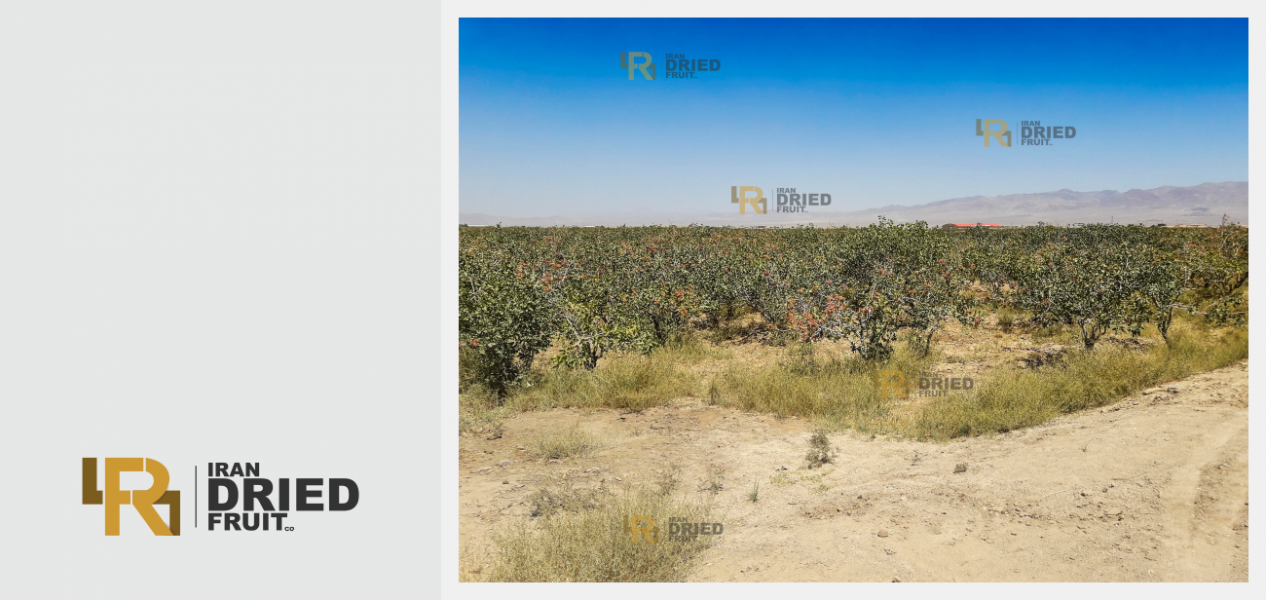
Iranian Pistachio Orchard During Harvest
Alt
Iranian pistachio orchard during the 2025 harvest season
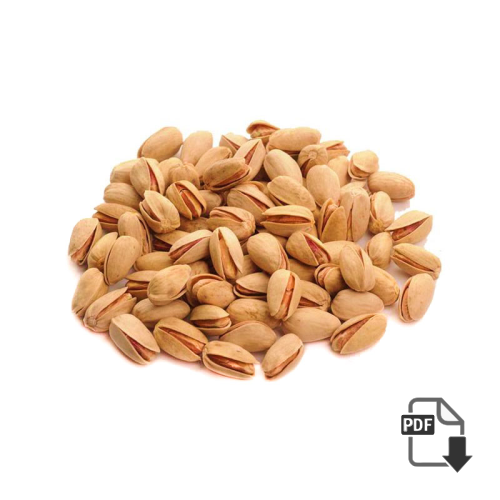
Premium Iranian Pistachios


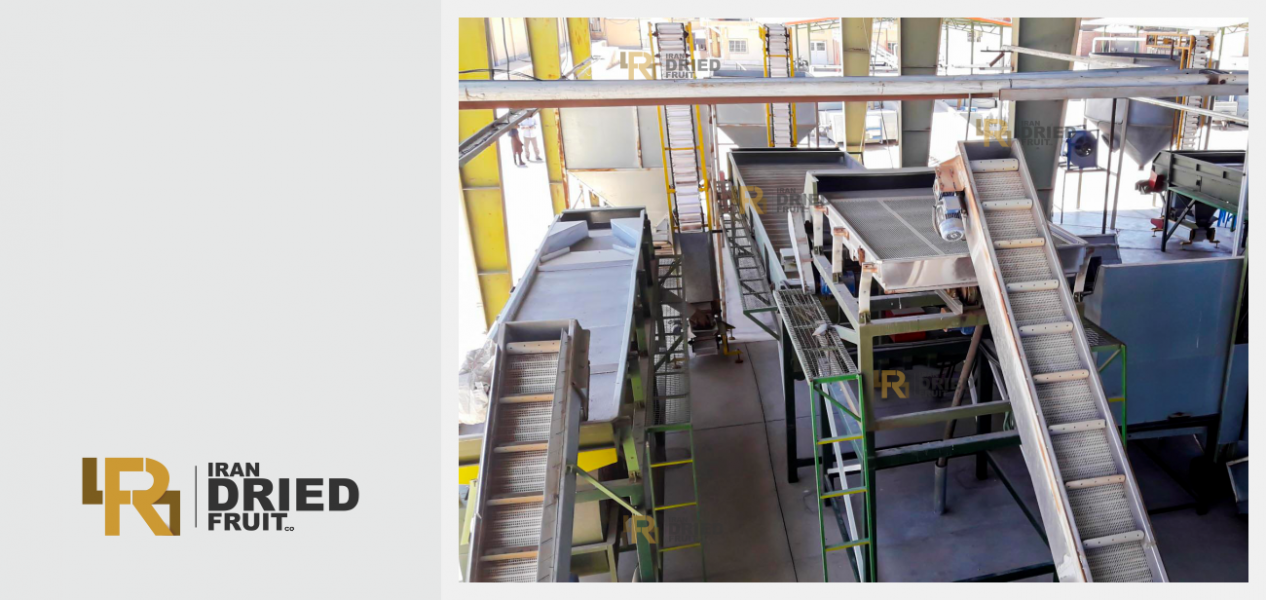
Sorting Pistachios
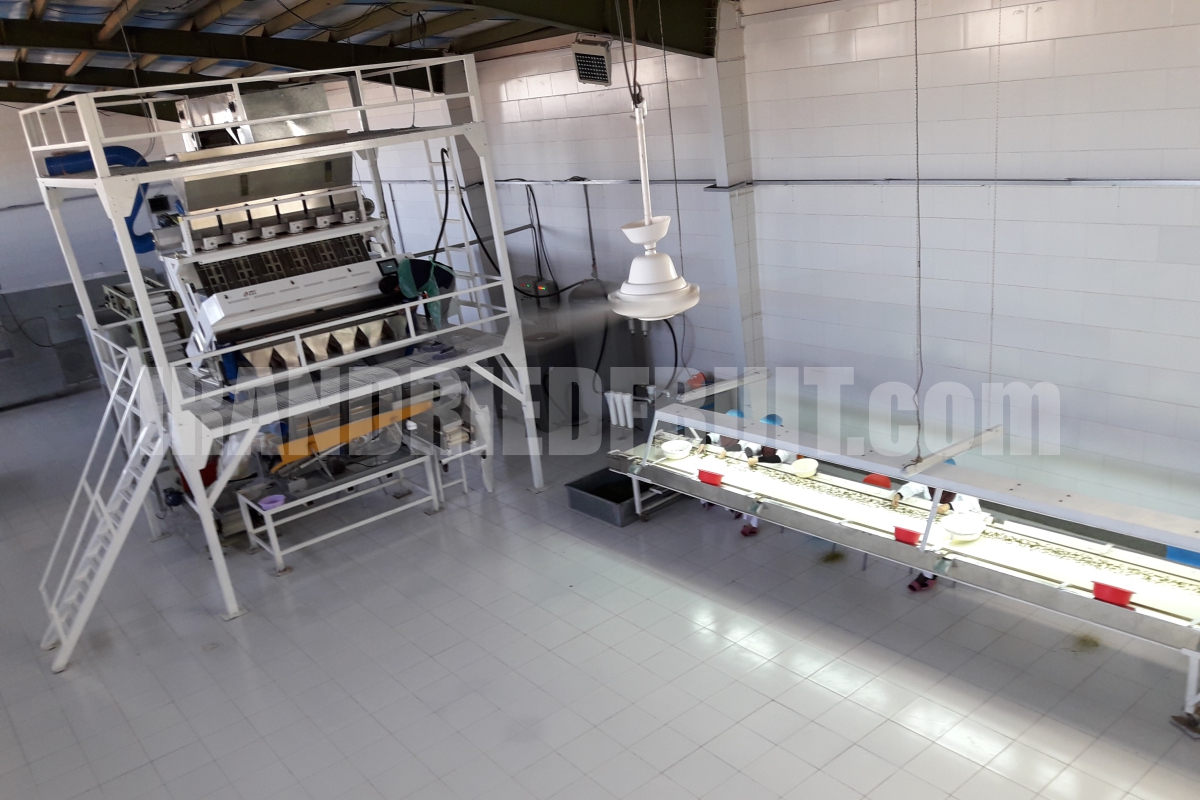
Processing Factory
Dried mixed pistachios should be sorted to different standard sizes :
round (fandoghi): 26-28, 28-30, 30-32, 32-34 pcs/OZ
long (Ahmad Aghee): 22-24, 24-26, 26-28, 28-30, 30-32 pcs/OZ
Jumbo (Kalleghuchi): 18-20, 20-22, 24-26, 26-28 pcs/OZ
Long (Akbari): 18-20, 20-22, 24-26, 26-28 pcs/OZ
Export Packing
iranian Ahmad Aghaei Pistachio Special price + analysis + sale offer
World Pistachio Market
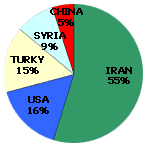
The global pistachio market has experienced strong growth over the past decade, driven by increasing consumer demand for healthy snacks, plant-based proteins, and premium confectionery products. Worldwide pistachio production for the 2025/26 marketing year is estimated at approximately 1.1 million metric tons, while the market value exceeded USD 5.5 billion in 2025 and is projected to continue growing at an annual rate of around 5% through the next decade. (Statista)
Major Producing Countries (2024/25)
| Country | Share of Global Production |
|---|---|
| United States | 63% |
| Turkey | 17% |
| Iran | 16% |
| Syria | 2% |
| Greece | 1% |
| Others | 1% |
Source: International Nut & Dried Fruit Council (INC), compiled by Statista. (Statista)
Key Market Trends
- United States remains the world’s largest producer and exporter, with California accounting for nearly all U.S. production.
- Iran is still recognized globally for premium-quality pistachios, particularly varieties such as Akbari, Ahmad Aghaei, Kalleh Ghouchi, and Fandoghi.
- Turkey continues to expand exports, supported by strong demand for Antep pistachios.
- Rising consumption in China, India, the European Union, and the Middle East is driving long-term market growth.
- Demand from the chocolate and confectionery industry—especially pistachio cream and “Dubai chocolate” products—has increased global prices in recent years. (Financial Times)
- Do Dried Prunes Have Iron?
Main Importing Markets
- China
- Germany
- India
- Italy
- Spain
- United Arab Emirates
- Saudi Arabia
- Canada
These countries represent major opportunities for exporters of premium Iranian pistachios.
Outlook:
The long-term outlook for the global pistachio market remains positive due to:
- Growing health awareness among consumers.
- Increasing demand for natural, high-protein snacks.
- Expansion of pistachio use in bakery, dairy, desserts, and confectionery.
- Growth of online food retail and premium food products.
Global Pistachio Production Share (2024/25)
Estimated share of worldwide pistachio production by major producing countries.
| country | share |
|---|---|
| United States | 63 |
| Turkey | 17 |
| Iran | 16 |
| Syria | 2 |
| Greece | 1 |
| Others | 1 |
Iran Climate Zones


Climate Zones of Iran
Iran is one of the world’s most climatically diverse countries due to its mountain ranges, deserts, and long coastlines. Based on recent climatological analyses, Iran can be divided into six major climate zones. (Royal Meteorological Society)
| Climate Zone | Main Regions | Characteristics |
|---|---|---|
| 1. Mild & Humid | Caspian Sea coast (Gilan, Mazandaran, Golestan) | High rainfall (800–2,000 mm/year), lush forests, mild winters, warm humid summers |
| 2. Cool & Sub-humid | Western Zagros Mountains | Moderate rainfall, cold winters, pleasant summers, suitable for agriculture |
| 3. Cold & Temperate Semi-arid | Northwest Iran | Cold snowy winters, warm summers, moderate precipitation |
| 4. Warm & Semi-arid | Southwest Iran (Khuzestan and nearby areas) | Hot summers, mild winters, moderate rainfall |
| 5. Cool & Arid | Northeastern Iran | Low rainfall, cold winters, dry climate |
| 6. Warm & Hyper-arid | Central Plateau, Dasht-e Kavir, Dasht-e Lut, Southeast Iran | Very low rainfall (<100 mm/year), extremely hot summers, desert climate |
(Royal Meteorological Society)
Climate Distribution
- Humid: ~10% (Caspian coast)
- Mountain & Semi-humid: ~25%
- Semi-arid: ~25%
- Arid & Hyper-arid: ~40%
This makes Iran one of the largest countries with extensive arid and semi-arid environments. (Agris)
Why Iran Has So Many Climate Types
- The Alborz Mountains trap moisture from the Caspian Sea, creating lush forests in the north.
- The Zagros Mountains receive winter rainfall from Mediterranean weather systems.
- The Central Plateau lies in a rain shadow, resulting in deserts such as Dasht-e Kavir and Dasht-e Lut.
- The Persian Gulf and Gulf of Oman coastlines experience hot, humid subtropical conditions. (Iranica Online)
For an export website (especially for pistachios, saffron, dried fruits, and agricultural products), this topic is valuable because it explains how Iran’s diverse climates contribute to the exceptional quality of its crops, helping international buyers understand the country’s agricultural advantages.
Ahmad Aghaei Pistachio:
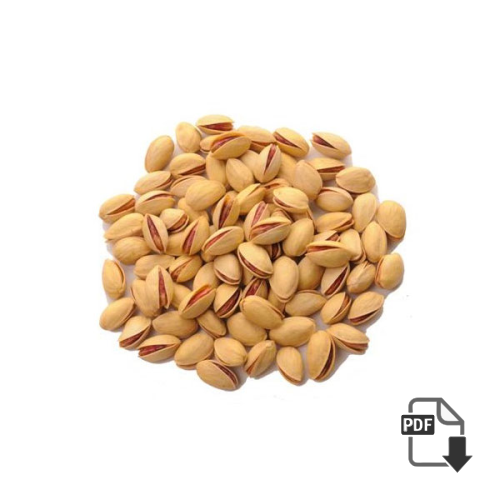
Premium Akbari Pistachio
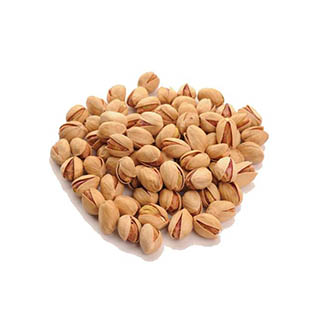
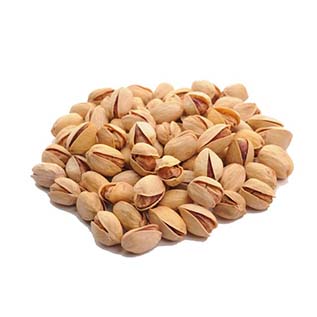
jumbo-pistachio-Kalle-ghuchi
Iran Pistachio Production Comparison
| Crop Year | Production (MT) | Change |
| 2024/2025 | 225,000 | — |
| 2025/2026 | 118,000 | −48% |
Main Causes of Production Decline
| Factor | Impact |
| Spring temperature fluctuations | Very High |
| Heat stress | Very High |
| Rain during pollination | High |
| Wind damage | Medium |
| Hail | Medium |
| Salinity stress | High |
| Bud drop | High |
| Kernel shriveling | Medium |
| Psylla infestation | High |
| Green stink bug | Medium |
Estimated Variety Distribution
| Variety | Share |
| Fandoghi | 25% |
| Ahmad Aghaei | 25% |
| Akbari | 20% |
| Other Long Varieties | 20% |
| Kaleh Ghouchi | 10% |
All Type Of Pistachios
-
Pistachio Akbari Super Long Special wholesale price + analysis + sale offer
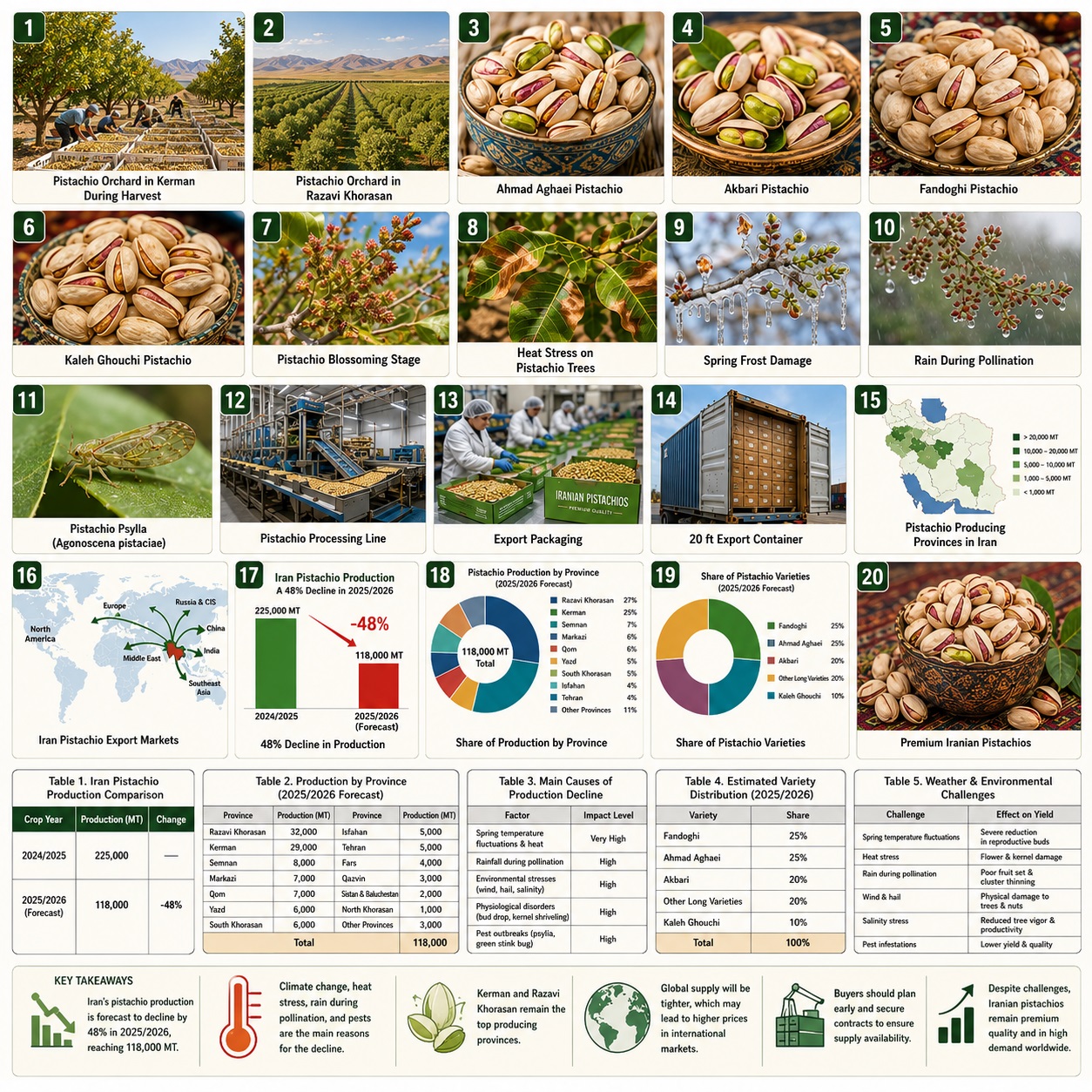
Another name for Long Akbari Pistachio is Super Long Pistachio. This name is based on the shape of the pistachio. This type of Pistachio is the most expensive and the oldest pistachio type in Iran. The reason why this type…
-
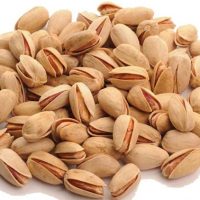
Round Pistachio | Fandoghi Pistachio Special price + analysis + sale offer
Round Iranian Fandoghi Pistachio High Quality Only for Export : This type of Pistachio is the least expensive type among all the pistachios. The reason why its price is lower than other types is because of its shape and high…
-
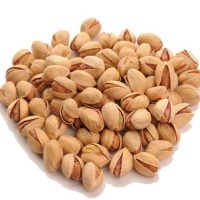
iranian Ahmad Aghaei Pistachio Special price + analysis + sale offer
Ahmad Aghaei Pistachio ( Long iranian Pistachios ) : This type of Pistachio (Long Ahmad Aghaei Pistachio) is one of the popular types. The reason why it is popular than the other type of pistachio is that it has the…
-
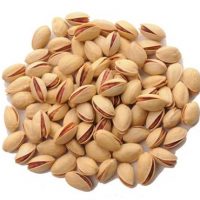
Iranian Jumbo Pistachio | Kale Ghuchi Pistachio Special price + analysis
This type of Pistachio is the most delicious type among all the pistachios. The reason why it is tastier than the others is it is fattier. The color of the Jumbo Pistachio shell is naturally light cream. As it is…
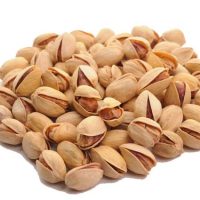
-
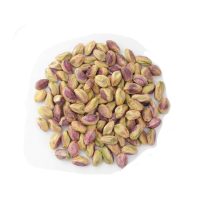
pistachio kernel Special wholesale price + analysis + sale offer
Producers make Pistachio Kernel from all types of Pistachios. A quality factor for kernels is their sizes. The more the color of the kernel`s second skin is violet and sharp the more it is popular among users. Higher the level…
-
Green Pistachio Kernel ( GPPK ) Special wholesale price
Producers make Pistachio Kernel from all types of Pistachios. A quality factor for kernels is their sizes. The more the color of the kernel`s second skin is violet and sharp the more it is popular among users. Higher the level…
 3 kind raisin